

During its November 9th meeting, Plymouth Township’s council voted 5-0 to authorize the advertisement of a zoning ordinance update. While not stated on the agenda or during the meeting, that update involves language that permits data centers by conditional use in the heavy industrial zoning district in the township. You can view this advertisement here. The proposed ordinance can be reviewed here (please note this was later added to the Proposed Ordinance section of the township website).
Over the past year, municipalities across Pennsylvania have moved to adopt ordinances to regulate data centers, as they can not be banned due to state law. One outlier in this process has been Plymouth Township. In April, Montgomery County issued a document for municipalities with recommendations on language and regulations to utilize for draft ordinances focused on data centers. In July, Plymouth Township released a statement in which the council “publicly stated that it believes the existing Zoning Ordinance already provides a lawful process for reviewing data centers through the Special Exception provisions of the ordinance.” It appears the council has changed its mind.
It is important to note that while developer Brian O’Neill was seeking a special exception for a data center at the former steel plant, the heavy industrial zoning district is larger than the steel plant. Any new ordinance wouldn’t be retroactive to O’Neill’s application, but it would create regulations for data centers on all the other heavy industrial property.
This article will focus on the transparency of how the vote to advertise was taken, not the specific language of the ordinance (that will come later). The advertisement is just the start of the process; nothing has been adopted yet (according to the notice linked above, the process will start on December 14).
However, with all the controversy and attention on the data center issue, when you compare a vote to advertise a proposed zoning change in July to the one on November 9th, there is a striking difference in the level of detail provided to the public.
The Agendas (on paper)
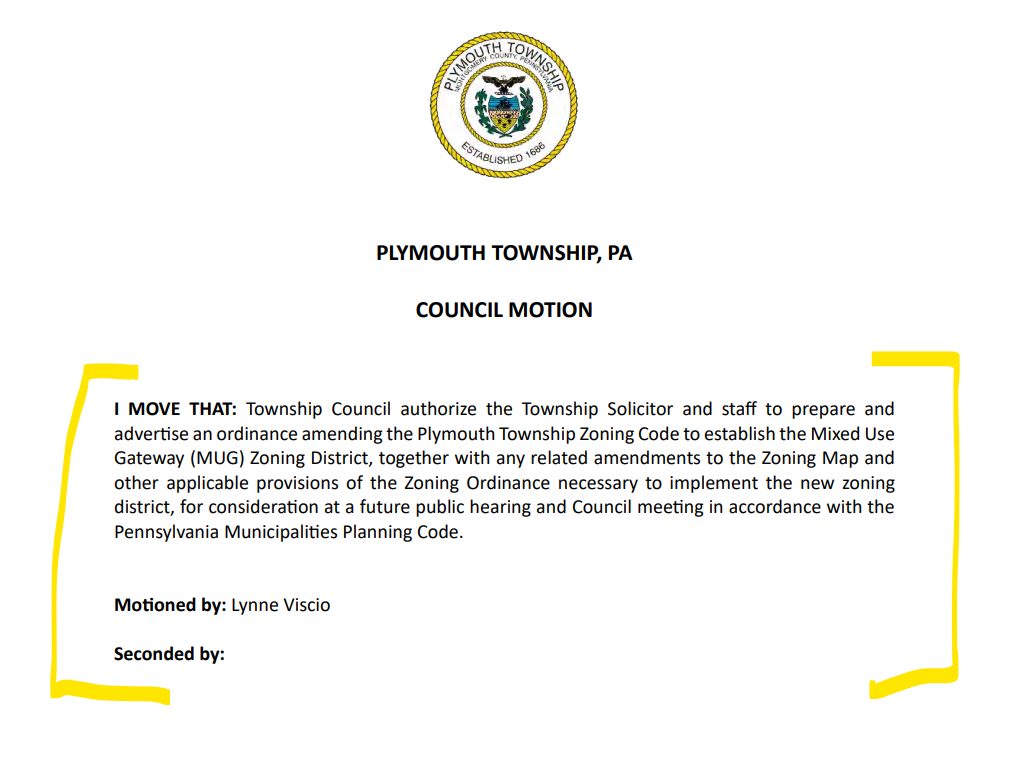
On the Monday, July 13th agenda for council, there was a vote to authorize the advertisement of an ordinance. The agenda included wording explaining what the ordinance involved: “Amending the Plymouth Township Zoning Ordinance to Establish the Mixed-Use Gateway (MUG) Zoning District.”

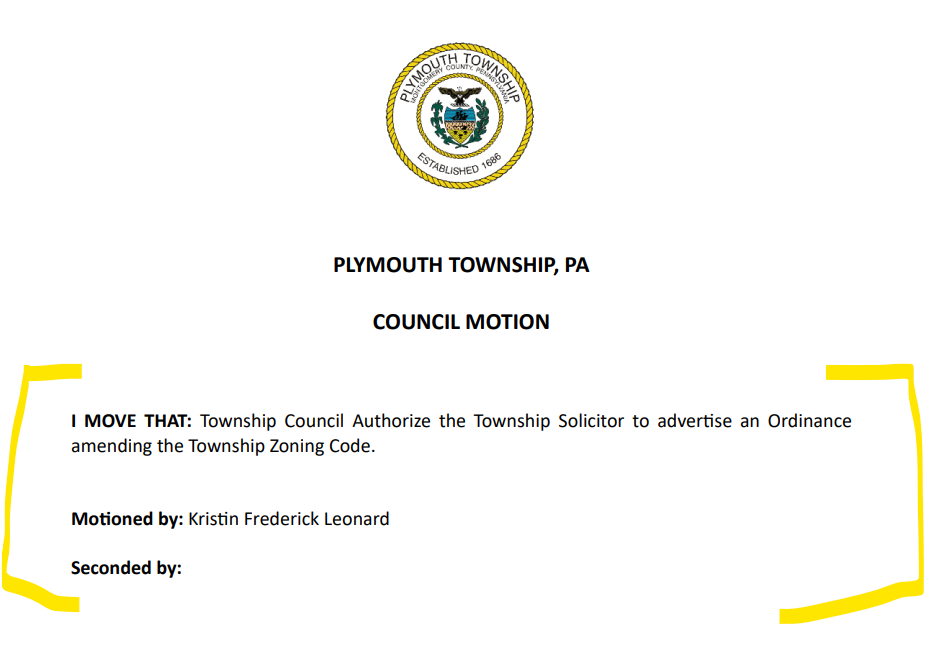
In a comparable situation, on the November 9th agenda, Plymouth Township included a motion to authorize the advertisement of a zoning ordinance update, but offered no description of what it actually involved.

The Motions (on paper)
Included with each agenda was a packet of supporting documents, including a page for the specific motions. As you can see, the July 13th explanation of the Mixed-Use Gateway ordinance was expanded upon beyond the initial listing on the agenda. In the case of the ordinance involving the data center on November 9th, the motion page offered no detail on the ordinance and made no mention of it involving data centers.
The Votes in the Meeting
We also want to show you what actually took place during the meetings. During the July 13th meeting, Council President Lynne Viscio read the motion, asked for a second, asked the other council members if they had questions or comments, and then asked the township manager if he wanted to provide additional context on the proposed ordinance (which he did).
On November 9th, it went much quicker. Councilmember Kristin Fredrick Leonard read the one-sentence motion; Viscio asked the council members if they had questions or comments, asked the public if they had comments, and the vote was held. The township manager was not asked to provide context on the proposed ordinance. No one mentioned that the proposed ordinance involved data centers. Every member of council had the opportunity to do so.
Just prior to that motion on the agenda, there was a vote on a motion involving how much Plymouth Township charges Villanova for the use of the baseball field at the Greater Plymouth Community Center. That lasted approximately four minutes. The motion for the data center ordinance took about 35 seconds.
Below, you can watch the pertinent parts of each meeting to compare. Each is cued to the appropriate point in the meeting.
On November 15th, MoreThanTheCurve.com asked the Plymouth Township Council and the township manager the following questions regarding the process we have outlined. We provided a window to 10:00 a.m. the following day. We did not receive a response. The questions were:
- The agenda for November 9th stated, “Motion to Authorize Advertisement of Zoning Ordinance Update.” Why was it not defined as involving data centers?
- Why, during the November 9th meeting, did Councilmember Leonard not state that this item involved data centers, and why did no other Council member state that fact?
- Why wasn’t the proposed language of the ordinance included in the meeting packet?
- Council President Viscio asked for public comment on this motion; however, there was no way for the public to know it involved data centers. Do any members of the council care to address how this process provided for transparency?
- This process was not added to the data center information page on the township website. Why wasn’t it?
- Was this proposed amendment reviewed by the township planning agency or the county planning commission?
MoreThanTheCurve.com asked two people participating in the opposition to the proposed data center at the steel plant if they were aware of the proposed ordinance. We received one response. A Plymouth Township resident, who asked not to be named, stated “The November 9 Council agenda described it simply as a ‘zoning ordinance update,’ without mentioning data centers. Regardless of whether individual notification was legally required, I believe residents deserved clearer communication about a proposal of this magnitude.”
This person continued, “Our township officials have a responsibility to protect the interests, health, safety, and quality of life of the people they serve. That responsibility goes beyond meeting the minimum legal requirements for public notice. It means being transparent, listening to residents, and ensuring our community has a meaningful voice in decisions that could affect us for generations.”
Let us know what you think in the comments.
Photo – eenevski from Getty Images via Canva