
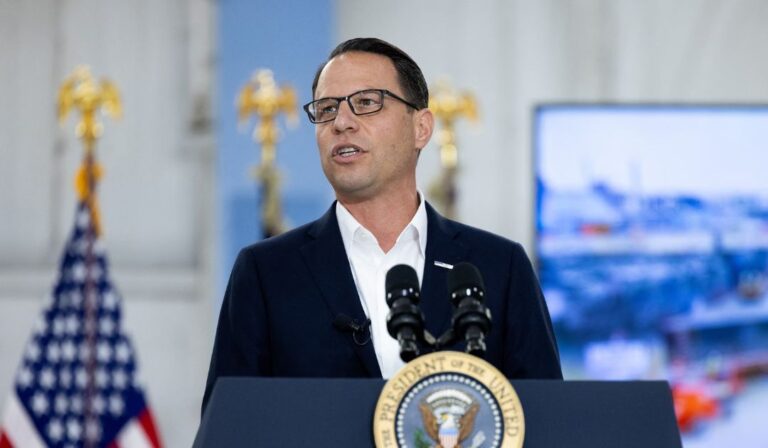
Governor Josh Shapiro joined a multi-state lawsuit that challenges an executive order issued by President Trump earlier this week.
The order calls on the Department of Homeland Security to compile a list of verified U.S. Citizens who are eligible to vote. It also directs the U.S. Postal Service to take new measures to ensure ballots are sent to eligible voters by placing a barcode on ballot envelopes.
“The U.S. Constitution makes clear that elections are to be run by the states, and here in Pennsylvania, we believe that the administration of elections should be nonpartisan,” Shapiro said in a statement. “The good people of Pennsylvania will vote — whether in person or by mail — their votes will be counted, and the will of the people will be respected. Pennsylvanians choose their representatives, not Donald Trump.”
The lawsuit is below:
In related news, Shapiro laid out a plan to challenge rising electric costs during his annual budget address Tuesday in Harrisburg.
“We need to have a hard conversation about the amount of profit utilities and their investors can make on the backs of hardworking Pennsylvanians,” Shapiro said. “S&P Global Ratings currently ranks Pennsylvania as one of the top four states in the country for utilities to make a profit.”
Shapiro said he wants the PUC to make the financial details of their rate-hike requests more transparent. He asked lawmakers to pass legislation that provides guidelines for the PUC and limits on utility profits.
“We grant these utilities a monopoly — and in exchange, they have a legal responsibility to keep their costs just and reasonable,” Shapiro said. “They shouldn’t get one dollar more than what they need to meet their customers’ needs.”
According to WHYY, electricity rates are on the rise in part because of a gap between supply and demand.
“As older plants shut down, new facilities have not come online fast enough to make up for the decrease,” they wrote. “At the same time, demand from data centers driven by a rise in artificial intelligence has put a strain on the grid.”
PECO said its plans to invest about $10 billion in infrastructure upgrades over the next five years will improve reliability.
“Investments like these have resulted in service reliability ranking PECO among the best in the nation as benchmarked against our peers, and as our performance during Winter Storm Fern showed, a resilient, well-funded grid is essential when customers need it most,” the statement read. “These investments also drive economic growth and support thousands of local jobs.”
Shapiro sued PJM Interconnection, the region’s grid operator, in December 2024 over their high rates. Weeks later, his office announced that it had reached an agreement with PJM on a plan to resolve his recent lawsuit and to save consumers over $21 billion over the next two years, including an estimated $4.2 billion for Pennsylvania ratepayers.
In January, Shapiro signed a “Statement of Principles” intended to reform PJM, as well as accelerate the construction of new energy generation, and protect families and businesses from rising electricity costs.