
Please note that we are publishing this as an opinion piece because we offer opinions on the issue of a potential home rule charter for the Borough of Conshohocken.
You may be aware that on the ballot for the November 3rd general election, Borough of Conshohocken voters will have two ballot questions to consider. The first reads as follows:
Shall a government study commission of seven members be elected to study the existing form of government of Conshohocken Borough, to consider the advisability of the adoption of a home rule charter, and if advisable, to draft and to recommend a home rule charter?
The second involves who should serve on the commission if a majority of voters decide that the commission should be established. Since no one managed to get their name on the ballot (we don’t think anyone actually tried), voters need to write in seven names.
So most people are probably asking themselves what a Home Rule Charter actually is. The clearest description we have found is from the City of Lancaster, which explains it as follows:
Home Rule is a type of local government available in Pennsylvania. It transfers the basic authority to act from state law to a local charter drafted, adopted, and amended by local voters. A Home Rule Charter is essentially a local constitution.
However, while a municipality has a constitution of its own, it can’t violate the state constitution, just as the state constitution can’t be in conflict with the U.S. Constitution.
Another good description can be found in a 2014 article from WHYY (which you should read in its entirety):
Under home rule, a county or municipality can do anything that’s not specifically denied by the state constitution, the General Assembly, or the charter itself. By contrast, municipalities run by municipal codes (state laws) can only act where specifically authorized by state law.
The bottom line? Home rule provides local control. It gives the municipal government the ability to craft ordinances and make decisions based on local needs, rather than having to follow a one-size-fits-all state code that’s decided by state legislators.
You might be surprised that the nearby municipalities of Plymouth Township, Whitemarsh Township, and Norristown are all governed by a home rule charter. Overall, Montgomery County has seven municipalities with a home rule charter, and there are 82 across the state.
What No One Is Talking About: Greater Taxing Power
Governing under a home rule charter removes state-mandated limits on some taxes, such as the Earned Income Tax. Neither side of the issue is highlighting this. From a 2024 SpotlightPA article on another community considering a home rule charter:
While the city of Reading is the only municipality in Berks County currently under a home rule charter, other Pennsylvania communities have opted to adopt it for greater taxing power in recent years. Many of these communities then increase the earned income tax rate to generate additional revenue.
In 2022, Beaver Falls City in Beaver County approved a home rule charter. Towamencin Township in Montgomery County followed in 2023, and during this election cycle, Lancaster residents also approved a home rule charter. Lancaster officials will use this new structure to increase its earned income tax.
Home Rule Charters and “Sewer Socialism”
Home rule charters are not socialism in themselves; however, socialists have made home rule charters relevant in recent years by utilizing them to prevent municipalities from selling sewer systems to for-profit companies.
In Norristown, which has been governed by a home rule charter since 1986, David McMahon successfully organized an effort that led to Norristown’s council reversing its decision to sell its sewer system. McMahon’s group NOPE, collected “sufficient signatures on a petition to compel council to either repeal the ordinance or create a referendum question,” according to a quote from then Municipal Administrator Crandall Jones in The Times Herald.
In Towamencin, Kofi Osei, led a successful effort to have a home rule charter adopted in 2024 after the board of supervisors approved the sale of its sewer system. Eventually, the supervisors terminated the sale. McMahon and Osei are now elected officials in their respective municipalities.
The local Democratic Socialists of America endorsed McMahon and Osei in their elections.
How Does this Apply to Conshohocken?
At the same time, Norristown and Towamencin were trying to sell their sewer systems; Conshohocken’s borough council considered it over a two-year period (2019-2021). Eventually, after receiving bids and some public pushback, the borough council decided against it.
While an effort to adopt a home rule charter did not occur during this time, “Sewer Socialism” was the spark.
The Current Home Rule Charter Effort in Conshohocken
Carol Smith led the opposition to selling the sewer system in Conshohocken. Today, she leads the group that gathered the signatures to put the home rule charter on the ballot. Smith has been an active resident in Conshy for years. She ran the first farmers’ market in modern times, served on the Shade Tree Committee (which doesn’t exist anymore), was an elected constable, and served on the board of the Conshohocken Sewer Board. She was also an active Democrat, and her questions about the sale of the sewer and other issues weren’t taken well by party leadership.
Smith and a small group gathered the necessary signatures to get the government study on the ballot. The signatures were challenged in court by Borough Council member Kathleen Kingsley (D, Ward 5). The court ruled that the signatures were valid.
What is Exactly on the Ballot
As we mentioned at the top of the article, the first question is whether a seven-member commission should be formed to study whether to adopt a home rule charter. The second question is who should serve on the commission. Even if you vote against the first question, you should still vote on the second, because if it passes, you want people you trust to conduct the study.
While no names appear on the ballot (because no one went through the process to be included on the ballot), there are two slates being promoted.
It is also very important to note that even if it passes and the commission is formed, the commission could find that no change is necessary.
The Commission – Write-In Efforts
The first is a bipartisan slate that includes Carol Smith, Vince Colandrea, Chris Mundiath, Carmen Musitano, Keith P-Hammitt, Betsy Weitzman, and Spencer Williams. Mundiath is the chair of the Conshohocken Republican Committee, which supports the ballot initiative.
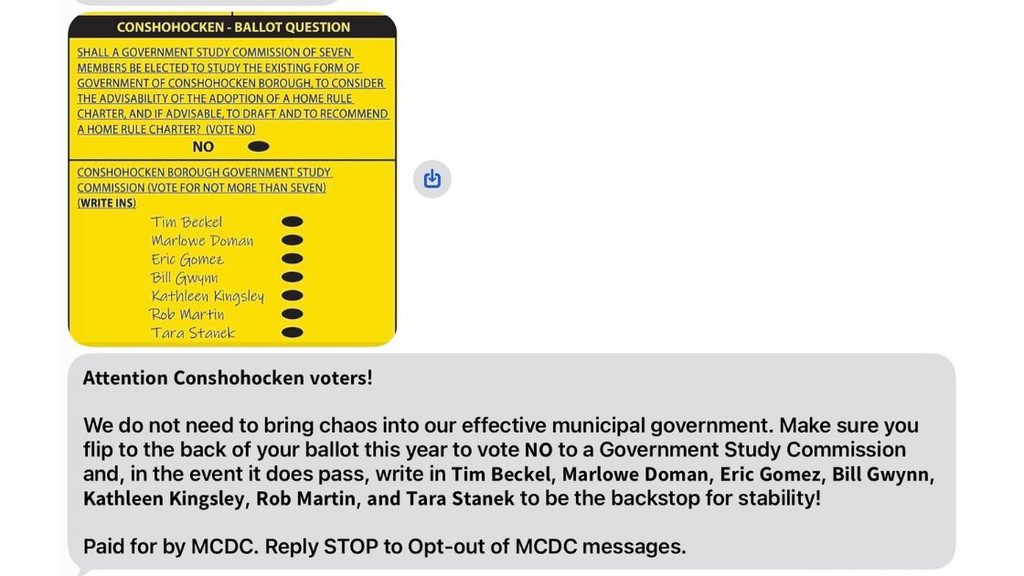
The Montgomery County Democratic Committee is against it and texted out a message that shows it hopes its followers are uninformed enough to follow blindly. It refers to the government study as “chaos” and encourages Democrats to vote for Tim Becklet, Malowe Doman, Eric Gomez, Bill Gwynn, Kathleen Kingsley, Rob Martin, and Tara Stanek to be members of the commission.
A study of governement effectiveness brings chaos? Plymouth, Whitemarsh, and Norristown’s local governments, where every member is a Democrat, are chaotic because they operate under a home rule charter? What unserious messaging.
Now What?
On November 3rd, it is your opportunity to vote on the issue. Do we think a government study is necessary? It can’t hurt. If you think the best and brightest are being elected to council, it’s not needed. If you want to consider another mechanism to keep them in check, the study is needed.
In regard to those seeking a position on the commission. You probably shouldn’t vote for anyone on either list. Just vote for neighbors you think are intellectually curious and reasonable people. Most residents have no idea who any of these people are, and you shouldn’t blindly put them in a position to potentially create Conshohocken’s constitution.
Photo – pixelshot via Canva (text added by MTTC)