

On the October 13th agenda for Plymouth Township’s council is a public comment policy meant to clarify how and when the public can comment during public meetings and hearings. The council reviewed and discussed the policy on October 5th and is scheduled to vote on it on October 13th. The township does not currently have a set policy.
Not having a policy doesn’t mean that the township was in any type of violation. It had allowed public comment as required by state law. Municipalities can meet the requirement in different ways. Some don’t have a formal policy; others have very strict policies as to when it is allowed. Policies include limiting speakers to municipal residents or business owners, time limits, etc.
In recent years, Plymouth Township has offered three opportunities for public comment during a meeting. There is a public comment period at the beginning of a meeting that is specific to items on the agenda. Council member Chris Manero (D, at-large) said that during his years on council, this opportunity for public comment was rarely used. The second opportunity is when the council votes on an item; the public can comment on that specific issue. Lastly, at the end of the meeting, members of the public can comment on other issues or topics. The police language also addresses decorum when giving public comment.
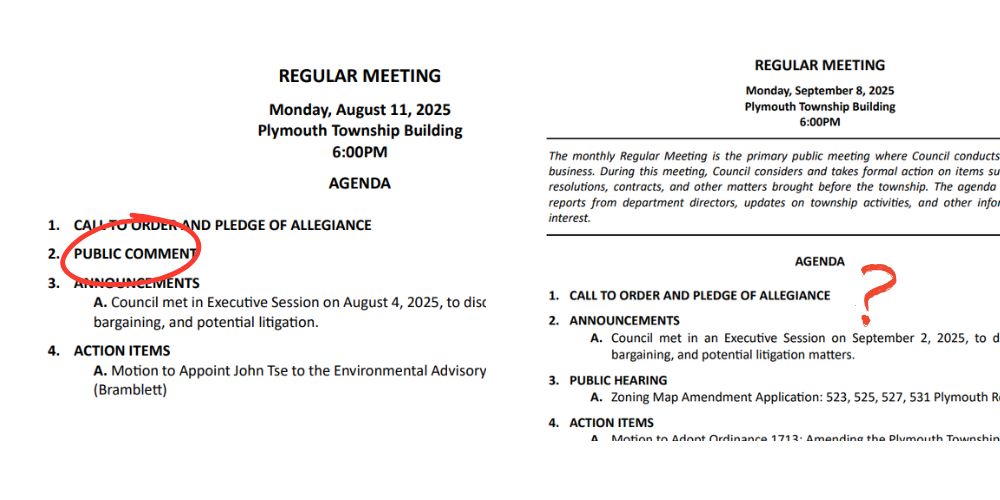
What is very common with Plymouth Township’s council, they don’t pay much attention to detail. If you look at recent agendas, they don’t list the public comment period that council members say they offer at the beginning of meetings. A public comment period at the beginning of a meeting hasn’t been included on a council agenda since August 11, 2025. We watched the September and October 2025 meetings, and public comment at the beginning was not offered, and the change was not acknowledged. The discussion on October 5th included references to this opportunity for public comment currently being offered.
Based on the discussion between council members, they want to remove the opportunity to make public comment on agenda items at the beginning of meetings (which again has been rarely used and, as we point out, has not been listed on agendas for a year) and formalize the permitted length of individual public comment to three minutes. During any action items, there would be an opportunity to offer public comment for each item. Then there would be the opportunity to bring up issues not on the agenda at the end of the meeting.
Hearings held by the council and the zoning hearing board would fall under a different set of rules. There would only be one public comment period after the applicant, township staff, consultants, or other appropriate parties have presented on the application.
You can watch the discussion from October 5th below (it is cued to the appropriate point in the video), and read the proposed policy language here (starting on page 128).
Photo – Mihaela Stoica’s Images via Canva