
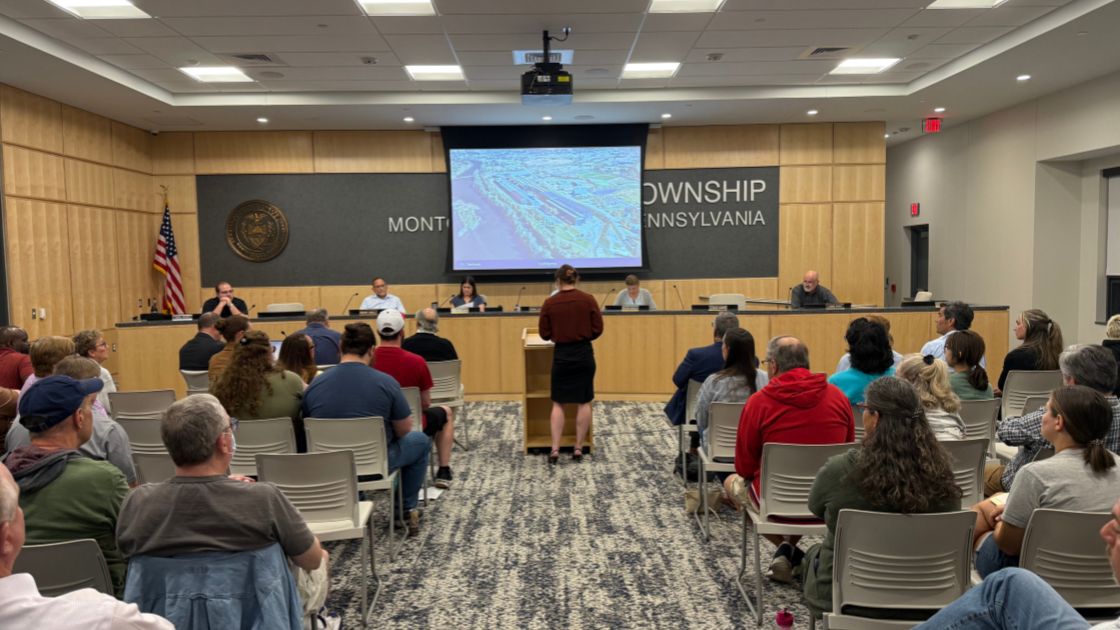
During the October 1st meeting of the Plymouth Township Planning Agency, the members of the agency voted 4-0 not to recommend a special exception to allow a data center at 900 Conshohocken Road in Conshohocken (Plymouth Township). Since 1832, this site has been a steel mill first operated by Alan Wood Steel. Its current owner, Cleveland Cliffs, recently idled the plant and offered the property for sale. The agency members did not offer an explanation for their decision not to recommend.
The special exception was sought by developer Brian O’Neill, who has the property under agreement. O’Neill’s development history in Conshohocken dates back to the mid-to-late 1980s when he repurposed the former Lee Tire property into an office campus. He would then go on to develop Millennium I-3 (office buildings), Riverwalk Apartments, and the Lumina Apartments (which opened as Londonbury under O’Neill’s ownership). He has also developed an office, a life science, a laboratory, and a data center across the Schuylkill River in Upper Merion.
Comparison to Laboratory and Warehouse
O’Neill’s presentation closely followed the application. He offered why he felt data centers are “consistent with and of the same general character” as laboratories and warehouses, which are already permitted under the current zoning. Regarding laboratories, he emphasized that they share a similar nature due to their requirement for careful engineering to maintain specific environmental conditions, redundant power systems, cooling systems, centralized and protected storage, security protocols, and compliance requirements.
When comparing data centers to warehouses, O’Neill noted that data centers are modern warehouses that store data and involve sophisticated operations, including various controls (such as climate control, security, etc.).
Concerns about Electricty and Water
O’Neill also spoke to address the two main concerns involving data centers, water, and electrical use. Regarding water, the proposed data center would be a closed-loop system, drawing no water from or discharging it into the river.
Regarding the concerns about the impact on the electrical grid and the price of electricity, O’Neill shared that the data center would not be powered from the grid but would tie into existing natural gas pipelines to power on-site turbines. He also suggested that the generators on-site, which serve as a backup system, could be utilized to add energy during peak periods to the grid through a program offered by PECO.
Generation of Tax Revenue
O”Neill pitched the data center as a financial boon to the township, Colonial School District, and Montgomery County. He estimated that it would generate $1,767,000 for the township, $15,897.00 for the school district, and $3,385,200 for the county. Those numbers would result in the data center paying 35.88% of all of the tax revenue generated by Plymouth Township, 14.6% for the Colonial School District, and 1% for the county.
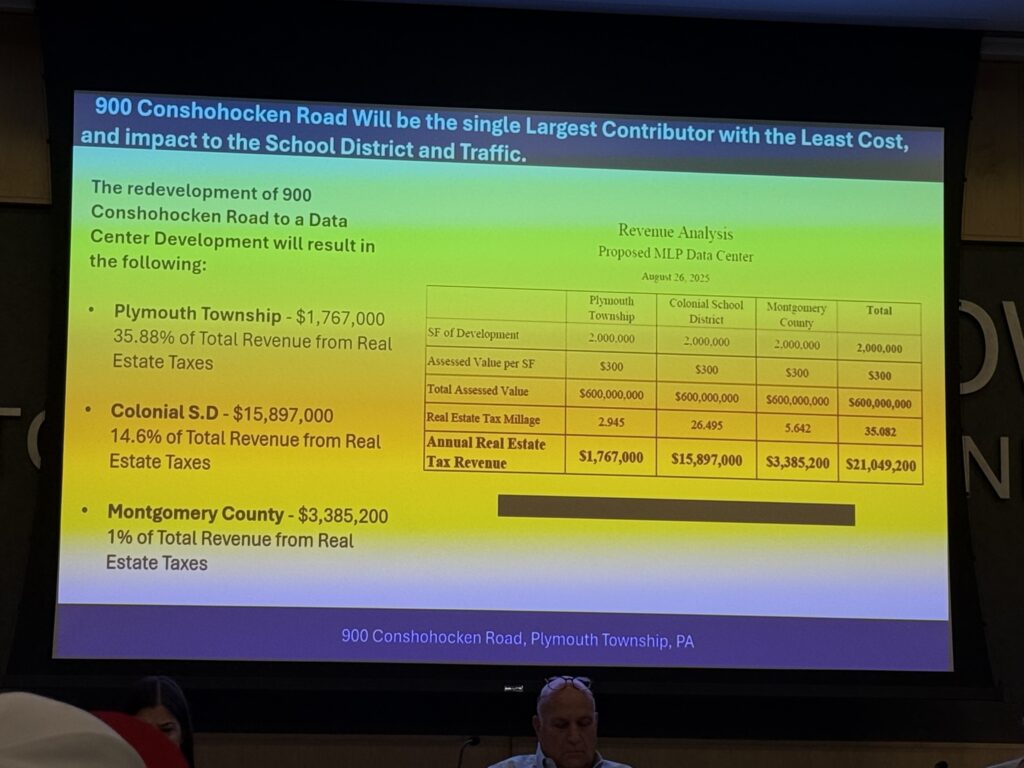
Tied to this, he pointed out that the Plymouth Meeting office market, which comprises a majority of the township, currently has a 40% vacancy rate and that, due to changes in the marketplace (such as work from home), the township needs to find other sources of tax revenue. O’Neill stressed that Plymouth Township has the largest vacancy rate in the region. If you would like to see this report, you can view it here (pg. 4).
This is also a concern for Plymouth Township Council members. During a September 8th meeting of the township’s council, during which an unrelated development proposal involving townhouses replacing office buildings was discussed, Councilmember Kristin Frederick Leonard stated that “I sat here and watched us refund millions of dollars in assessments. And so, everyone is worried about their taxes. Us getting tax income benefits you. Then we won’t have to raise taxes.” You can watch this statement here.
Related to this, O’Neill also shared that he believed the data center would attract new businesses to the township, as it would be attractive to businesses that need its services.
Public Comment
The meeting was standing room only, and every member of the public who spoke was against the data center. Concerns raised during public comment were that a data center was not comparable to a laboratory or warehouse, the retention of industrial uses along the riverfront, and sound, light, and air pollution. Several people who work in data, AI, and life sciences also challenged O’Neill’s presentation regarding the needs for those industries, citing their experience.
What Next
O’Neill will now need to decide whether to bring it before the township’s zoning hearing board, which would make the final determination on the issue. He could also decide to seek a zoning amendment from the township’s council to allow a data center within the industrial zoning district.
You can listen to the audio of the meeting below.