
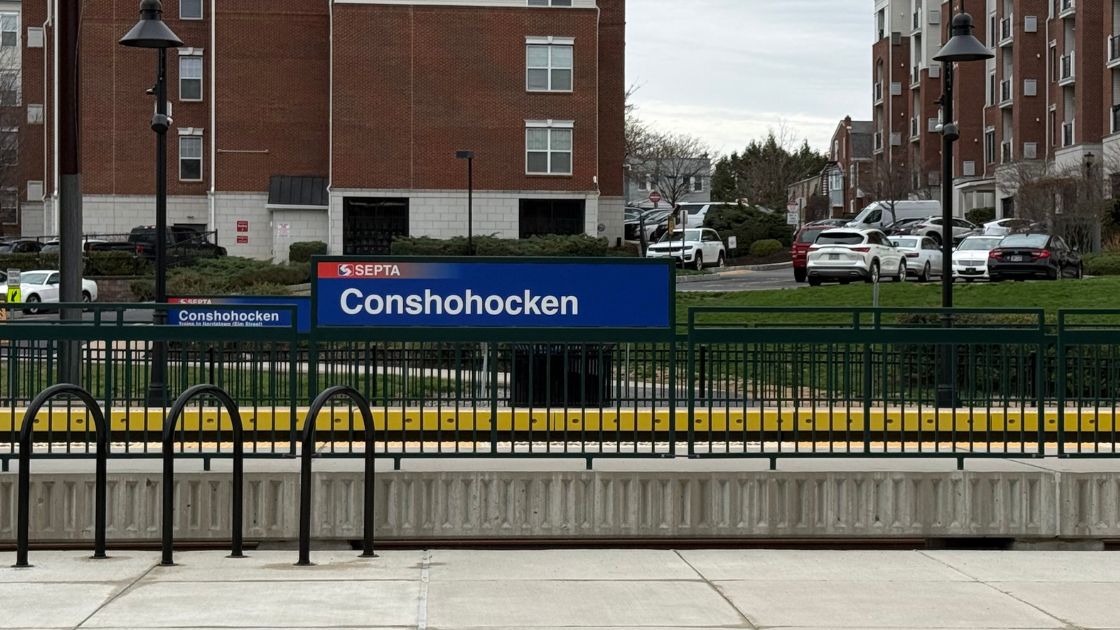
A sea of surface parking lots and garages. That is not an incorrect description of Conshohocken’s riverfront.
Please note that this isn’t meant to be an anti-apartment post. We just think that when it comes to “TOD” or transit-oriented development, it is a terrible argument to be the basis on why to build apartments in Conshohocken.
What is TOD? From the Delaware Valley Regional Planning Commission:
Transit-oriented development (TOD) is compact, mixed use development within an easy walk of a transit station. Its pedestrian-oriented design encourages residents and workers to drive their cars less and ride mass transit more. These “transit villages” are usually moderate to high density, matching the existing scale of development, and can be new construction or redevelopment. Mixed uses include residential, commercial, and office, or some combination.
Over the past 25 years, there have been 1,617 apartments and 387 condominiums constructed on or just off Conshohocken’s riverfront (within the Borough of Conshohocken). That constitutes about 3,000 people. Please note that we did not include any apartments or condos currently under construction.
Proximity to the train station was a big selling point in their development.
There are 101 parking spots at the Conshohocken Train Station.
When the new station opened at the end of 2023, SEPTA’s announcement on the opening stated that the station had “an average of approximately 500 weekday riders.”
To be fair, it is important to give some relevant timing. The Birch and Matson Mill had opened a year prior to the station. Madison West Elm opened at the same time as the station.
So, now three years post-station-opening, and full occupancy at the newer apartments, what is the daily weekday ridership?
We spent an hour trying to find a new number for daily ridership out of the station, but couldn’t. However, the impact of the newer apartments likely wouldn’t have been clear. In a November 2025 report, SEPTA offered that overall, regional rail ridership had declined by “10% or 8,531 trips per day relative to this time last year due to the SLIV car shortage and the SLIV FRA safety inspection mandate.”
So the number is likely sitting somewhere around 600.
But don’t forget those parking spaces.
So, 600 weekday riders minus the 101 parking spaces equals 499. Then there are some people who walk down to the station from the neighborhoods. So let’s say about 50. Now we are at 450. Again, these are all approximations.
That leaves 450 coming from the 2,004 apartments and condos, or about 3,000 people generating about 450 weekday SEPTA users (just 15% of the 3,000).
The plan for the SEPTA-backed apartment community near the train station in Conshohocken is 300 units. Based on the numbers we broke down, that will generate approximately 75 riders.
Now, I am sure the transit activists will be swooning about 75 riders per apartment community. But that ignores the impact of the majority of people who live in the apartments, such as more concrete jungle and cars on the road (and let’s face it, even from those taking the train).
So instead of calling apartments TOD, they should be called driver-oriented or working-from-home oriented.
Our point is that any new apartments shouldn’t be based on proximity to the train. It should be based on everyone who isn’t taking the train, which is the vast majority.
And don’t blame me for this. SEPTA has hyped this development as a way to increase its ridership. Is another 75 train riders worth it, when it really means more cars on the road? Is SEPTA’s ridership Conshohocken’s problem to fix?
So, Conshohocken, when the developer and SEPTA come in to talk about transit-oriented development, ignore them and base any decision on everything else the apartments will impact.
More apartments should only be allowed if they are beneficial to Conshohocken. Don’t let SEPTA, Montgomery County, or anyone else convince you otherwise.
Please note that the proposed apartments have not yet been officially submitted or appeared on any agenda.